Making a service available on the internet requires a lot of thought to minimize the potential for system compromise and associated security risks. All application traffic to App Engine is propagated via the Google Front End (GFE) service to mitigate access protocol compromise.
GFE provides a Transport Layer Security (TLS) termination for all GAE-registered routed web traffic. Acting as a protection layer, GFE is capable of performing several essential security services for a Google Cloud project. From a security perspective, it provides the public IP hosting of a public DNS name and Denial of Service (DoS) protection. Besides, GFE can also be used by internal services as a scalable reverse proxy.
When working on Google Cloud, a term commonly mentioned is security in depth. An approach such as this provides multiple concurrent safeguards for your environment that work against bad actors wishing to misuse your service. Many of these security safeguards are built into the platform, so no additional effort is required on the part of the developer.
GAE provides a fully managed application platform that enables developers to only concern themselves with building their application. Concerns regarding the management of lower-level infrastructures, such as compute and storage, are automatically managed by the service. In this respect, serverless solutions such as GAE offer the ability to devote focus to the development process and leave operational matters to the provider of the service.
GAE enables developers to take advantage of a simplified serverless environment that addresses hosting the web application and API services on Google Cloud. By providing a significantly simplified environment, the intent is to increase the adoption of the cloud platform by bringing more developers to the cloud. In most instances, when a developer uses such a system, they can immediately see the vast potential for efficiency to be gained by working within an environment such as this.
In the following diagram, we outline a logical view of the typical workflow of an environment based on GAE. From the illustration, we can see that all external communication is performed using the HTTP(S) protocol and is routed via Cloud Load Balancer (provided by GFE). In this scenario, the frontend device exposes a single service name that encapsulates the application resource deployed. The service enables GAE to direct traffic received to multiple backend resource components dynamically. GAE maintains responsibility for establishing which role these components performed and ensures that each of them remains distinct for the purposes of identification:
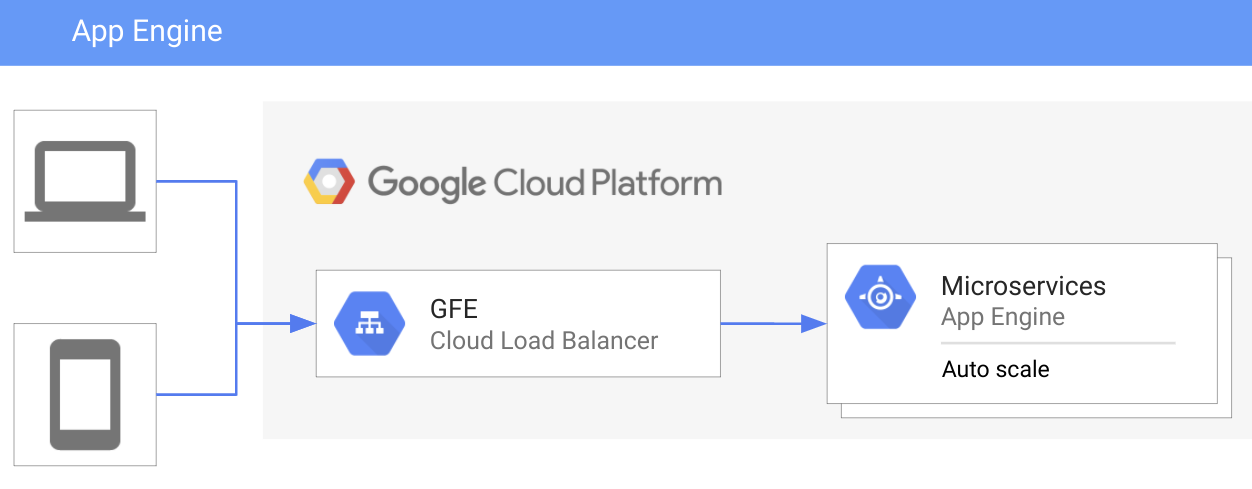
Backend service communication use the HTTP/HTTPS protocol, which means that GAE assumes an internet-based environment (that is, it assumes that you have access to a public-facing internet connection). Application request processing is performed by the default instance that's deployed, and this instance is subject to autoscaling based on system workload thresholds.
Taking the described approach enables workloads to be seamlessly load balanced across application instances, again without any additional configuration needed from the developer. Standard workload operational activities such as TLS termination and DNS resolution require no further user configuration. The addition of these activities provides a significant benefit to the developer. Application workloads being subject to isolated instances means the application is also capable of massive scale without any substantive work.
In addition to standard protection, the addition of GFE also provides seamless compatibility with secure delivery protocols such as gRPC (https://grpc.io/blog/principles/). The gRPC protocol uses the RPC framework to provide layer isolation when forwarding requests for the service. Also, communication remains encrypted by default to avoid the nuisance of communication eavesdropping or device compromise when performing inter-service communication.
The more recent adoption by the industry has seen broader adoption of gRPC developing more extensive compatibility across a range of services. The RPC security protocol is used extensively at Google, for example, to secure API access. When working with communication protocols across the internet, many standards exist. Having all service-related traffic routed through GFE means an incredibly flexible and scalable frontend is available without any additional work.
There are two versions of the App Engine available:
- App Engine Standard
- App Engine Flex
Both versions share many commonalities, and the majority of what's outlined in this chapter will apply to both equally. However, there are some key attributes to call out when thinking about the two environments, highlighted in the following diagram:
One of the main things to call out in the preceding diagram is that App Engine Standard scales down to zero. However, an App Engine Flex environment scales down to a minimum of one instance. Therefore, if your primary consideration is cost, use App Engine Standard. Being able to scale down to zero provides a real advantage over the App Engine Flex environment, which will always have a cost associated with it.
The ability of GAE Standard to scale to zero is due to the use of a sandbox environment. Using a dedicated sandbox provides quicker responses, that is, quicker start-up times and auto-scaling responses. Having deployment time measured in seconds may also be an advantage that appeals when considering the level of flexibility that may be required by different application growth patterns.
Unlike the standard environment, GAE Flex uses Google Compute Engine (GCE), more specifically Managed Instance Groups (MIGs), to enable auto-scaling. An overhead of one compute instance is always present for GAE Flex when working within this environment. Resultant costs also need to factor in how many compute resources GAE Flex requires. Maintaining an application in this environment will also mean a slower initialization time (that is, cold boot) due to the requirement to spin up a GCE instance plus a container environment for any flexible-based deployed application.
There are further differences evident in the application environments. However, the preceding characteristics are the ones that commonly impact decision making when starting to build an application on GAE.


 United States

 Great Britain
 India
India
 Germany
 France
 Canada
 Russia
 Spain
Spain
 Brazil
 Australia
 Singapore
 Canary Islands
 Hungary
 Ukraine
 Luxembourg
 Estonia
 Lithuania
 South Korea
 Turkey
 Switzerland
 Colombia
 Taiwan
 Chile
Chile
 Norway
 Ecuador
 Indonesia
 New Zealand
 Cyprus
 Denmark
 Finland
 Poland
 Malta
Malta
 Czechia
 Austria
 Sweden
 Italy
Italy
 Egypt
Egypt
 Belgium
 Portugal
 Slovenia
 Ireland
 Romania
 Greece
 Argentina
 Netherlands
 Bulgaria
 Latvia
 South Africa
 Malaysia
 Japan
Japan
 Slovakia
 Philippines
 Mexico
 Thailand