Search icon CANCEL
Subscription
0
Cart icon
Your Cart (0 item)
Close icon
You have no products in your basket yet
Save more on your purchases! discount-offer-chevron-icon
Savings automatically calculated. No voucher code required.
Arrow left icon
Explore Products
Best Sellers
New Releases
Books
Events
Videos
Audiobooks
Packt Hub
Free Learning
Arrow right icon
timer SALE ENDS IN
0 Days
:
00 Hours
:
00 Minutes
:
00 Seconds
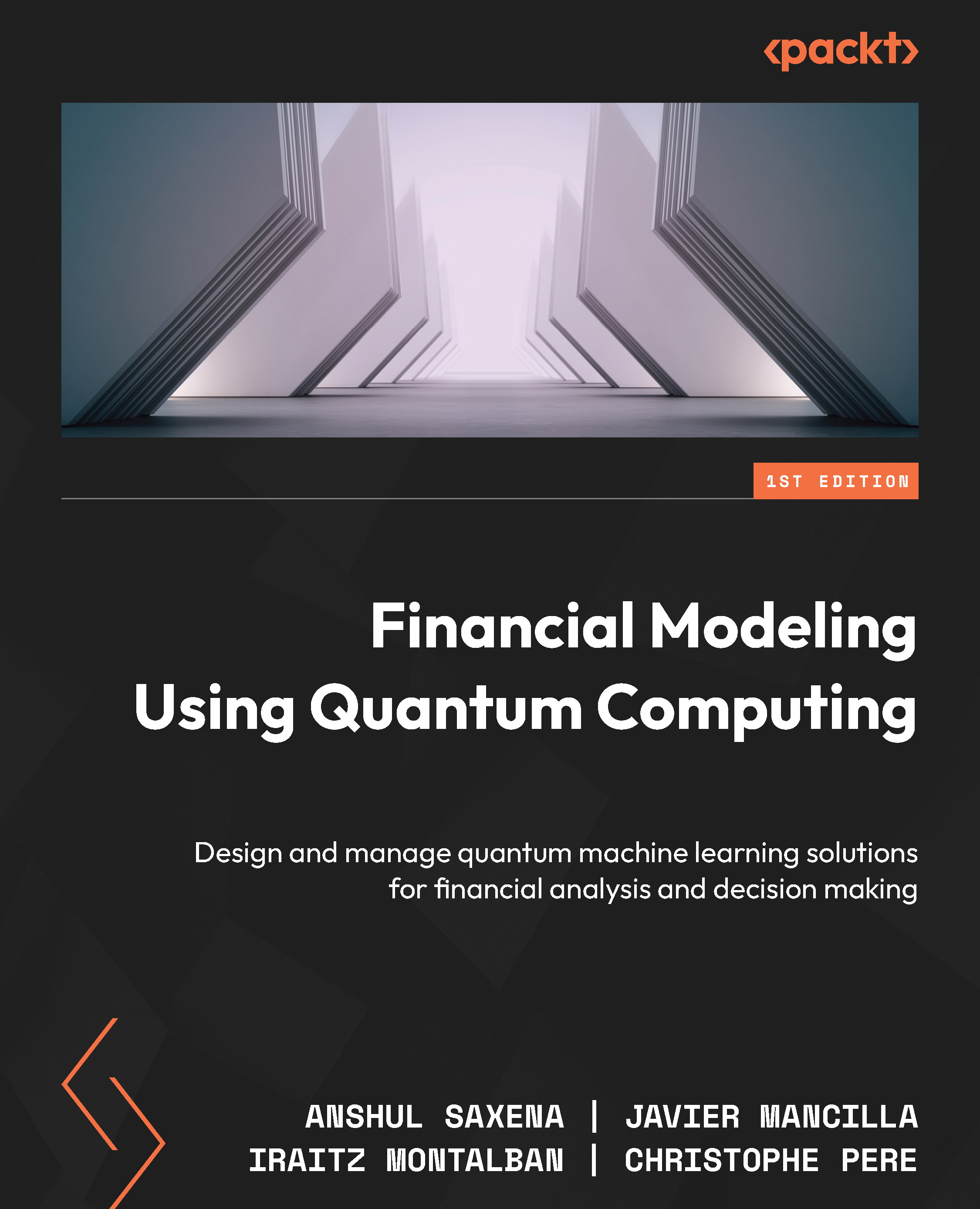
Financial Modeling Using Quantum Computing

Financial Modeling Using Quantum Computing: Design and manage quantum machine learning solutions for financial analysis and decision making

Arrow left icon
Profile Icon Anshul Saxena Profile Icon Javier Mancilla Profile Icon Iraitz Montalban Profile Icon Christophe Pere
Arrow right icon
€29.99
Full star icon Full star icon Full star icon Full star icon Full star icon 5 (7 Ratings)
Paperback May 2023 292 pages 1st Edition
eBook
€21.59 €23.99
Paperback
€29.99
Subscription
Free Trial
Renews at €18.99p/m
Arrow left icon
Profile Icon Anshul Saxena Profile Icon Javier Mancilla Profile Icon Iraitz Montalban Profile Icon Christophe Pere
Arrow right icon
€29.99
Full star icon Full star icon Full star icon Full star icon Full star icon 5 (7 Ratings)
Paperback May 2023 292 pages 1st Edition
eBook
€21.59 €23.99
Paperback
€29.99
Subscription
Free Trial
Renews at €18.99p/m
eBook
€21.59 €23.99
Paperback
€29.99
Subscription
Free Trial
Renews at €18.99p/m

What do you get with Print?

Product feature icon Instant access to your digital copy whilst your Print order is Shipped
Product feature icon Paperback book shipped to your preferred address
Product feature icon Redeem a companion digital copy on all Print orders
Product feature icon Access this title in our online reader with advanced features
Product feature icon DRM FREE - Read whenever, wherever and however you want
Product feature icon AI Assistant (beta) to help accelerate your learning
Modal Close icon
Payment Processing...
tick Completed

Shipping Address

Billing Address

Shipping Methods
Table of content icon View table of contents Preview book icon Preview Book

Financial Modeling Using Quantum Computing

Left arrow icon Right arrow icon
Download code icon Download Code

Key benefits

  • Learn to solve financial analysis problems by harnessing quantum power
  • Unlock the benefits of quantum machine learning and its potential to solve problems
  • Train QML to solve portfolio optimization and risk analytics problems

Description

Quantum computing has the potential to revolutionize the computing paradigm. By integrating quantum algorithms with artificial intelligence and machine learning, we can harness the power of qubits to deliver comprehensive and optimized solutions for intricate financial problems. This book offers step-by-step guidance on using various quantum algorithm frameworks within a Python environment, enabling you to tackle business challenges in finance. With the use of contrasting solutions from well-known Python libraries with quantum algorithms, you’ll discover the advantages of the quantum approach. Focusing on clarity, the authors expertly present complex quantum algorithms in a straightforward, yet comprehensive way. Throughout the book, you'll become adept at working with simple programs illustrating quantum computing principles. Gradually, you'll progress to more sophisticated programs and algorithms that harness the full power of quantum computing. By the end of this book, you’ll be able to design, implement and run your own quantum computing programs to turbocharge your financial modelling.

Who is this book for?

This book is for financial practitioners, quantitative analysts, or developers; looking to bring the power of quantum computing to their organizations. This is an essential resource written for finance professionals, who want to harness the power of quantum computers for solving real-world financial problems. A basic understanding of Python, calculus, linear algebra, and quantum computing is a prerequisite.

What you will learn

  • Explore framework, model and technique deployed for Quantum Computing
  • Understand the role of QC in financial modeling and simulations
  • Apply Qiskit and Pennylane framework for financial modeling
  • Build and train models using the most well-known NISQ algorithms
  • Explore best practices for writing QML algorithms
  • Use QML algorithms to understand and solve data mining problems
Estimated delivery fee Deliver to Malta

Premium delivery 7 - 10 business days

€32.95
(Includes tracking information)

Product Details

Country selected
Publication date, Length, Edition, Language, ISBN-13
Publication date : May 31, 2023
Length: 292 pages
Edition : 1st
Language : English
ISBN-13 : 9781804618424
Category :
Languages :
Concepts :
Tools :

What do you get with Print?

Product feature icon Instant access to your digital copy whilst your Print order is Shipped
Product feature icon Paperback book shipped to your preferred address
Product feature icon Redeem a companion digital copy on all Print orders
Product feature icon Access this title in our online reader with advanced features
Product feature icon DRM FREE - Read whenever, wherever and however you want
Product feature icon AI Assistant (beta) to help accelerate your learning
Modal Close icon
Payment Processing...
tick Completed

Shipping Address

Billing Address

Shipping Methods
Estimated delivery fee Deliver to Malta

Premium delivery 7 - 10 business days

€32.95
(Includes tracking information)

Product Details

Publication date : May 31, 2023
Length: 292 pages
Edition : 1st
Language : English
ISBN-13 : 9781804618424
Category :
Languages :
Concepts :
Tools :

Packt Subscriptions

See our plans and pricing
Modal Close icon
€18.99 billed monthly
Feature tick icon Unlimited access to Packt's library of 7,000+ practical books and videos
Feature tick icon Constantly refreshed with 50+ new titles a month
Feature tick icon Exclusive Early access to books as they're written
Feature tick icon Solve problems while you work with advanced search and reference features
Feature tick icon Offline reading on the mobile app
Feature tick icon Simple pricing, no contract
€189.99 billed annually
Feature tick icon Unlimited access to Packt's library of 7,000+ practical books and videos
Feature tick icon Constantly refreshed with 50+ new titles a month
Feature tick icon Exclusive Early access to books as they're written
Feature tick icon Solve problems while you work with advanced search and reference features
Feature tick icon Offline reading on the mobile app
Feature tick icon Choose a DRM-free eBook or Video every month to keep
Feature tick icon PLUS own as many other DRM-free eBooks or Videos as you like for just €5 each
Feature tick icon Exclusive print discounts
€264.99 billed in 18 months
Feature tick icon Unlimited access to Packt's library of 7,000+ practical books and videos
Feature tick icon Constantly refreshed with 50+ new titles a month
Feature tick icon Exclusive Early access to books as they're written
Feature tick icon Solve problems while you work with advanced search and reference features
Feature tick icon Offline reading on the mobile app
Feature tick icon Choose a DRM-free eBook or Video every month to keep
Feature tick icon PLUS own as many other DRM-free eBooks or Videos as you like for just €5 each
Feature tick icon Exclusive print discounts

Frequently bought together


Stars icon
Total 115.97
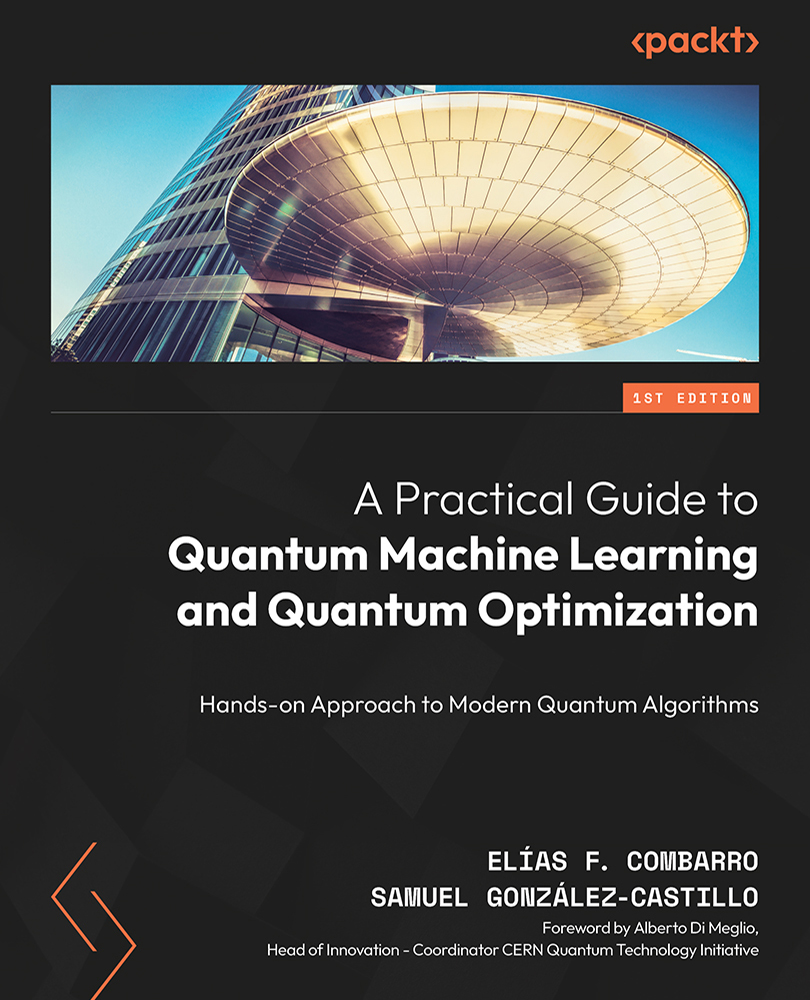
A Practical Guide to Quantum Machine Learning and Quantum Optimization
€41.99
Financial Modeling Using Quantum Computing
€29.99
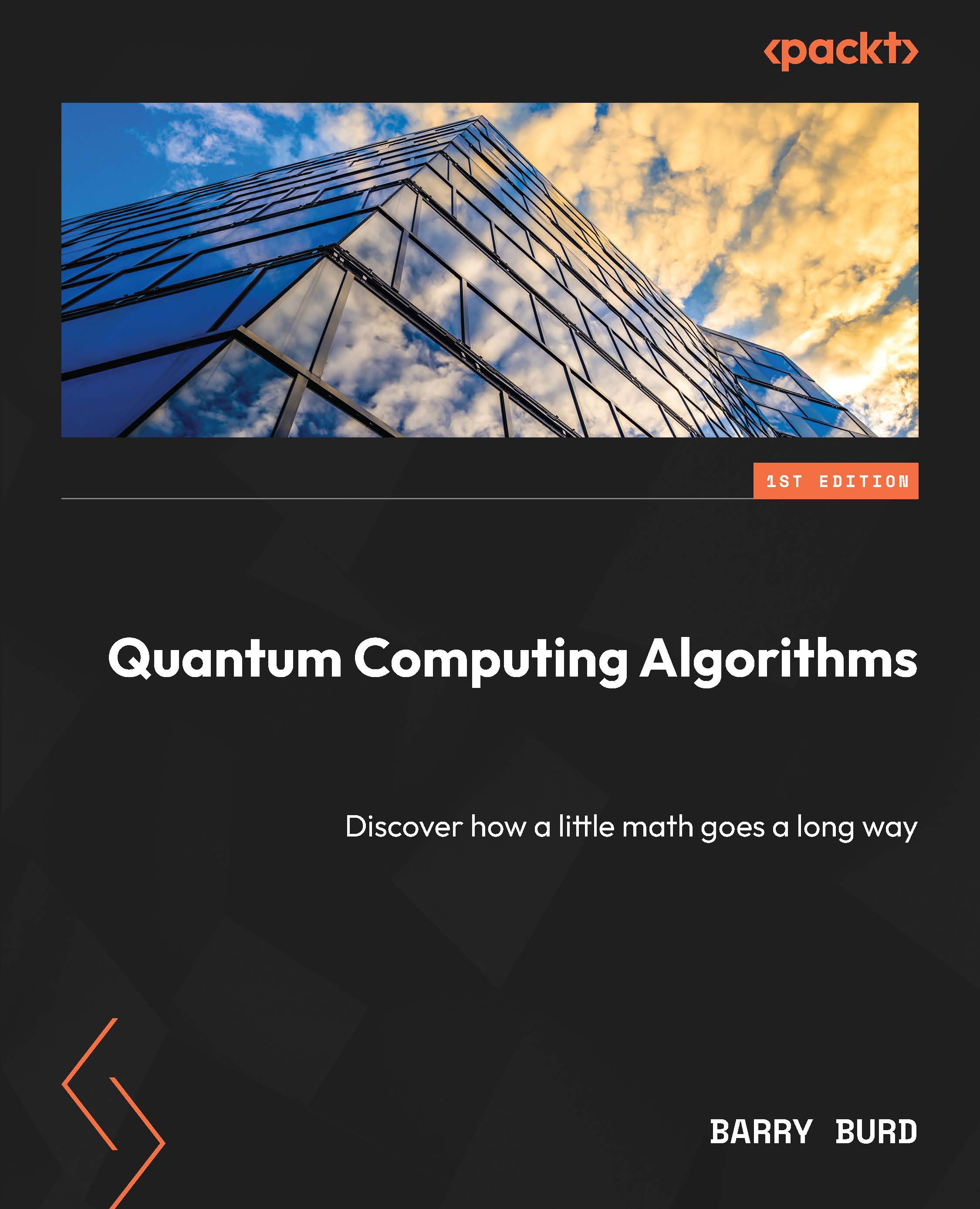
Quantum Computing Algorithms
€43.99
Total 115.97 Stars icon

Table of Contents

15 Chapters
Part 1: Basic Applications of Quantum Computing in Finance Chevron down icon Chevron up icon
Chapter 1: Quantum Computing Paradigm Chevron down icon Chevron up icon
Chapter 2: Quantum Machine Learning Algorithms and Their Ecosystem Chevron down icon Chevron up icon
Chapter 3: Quantum Finance Landscape Chevron down icon Chevron up icon
Part 2: Advanced Applications of Quantum Computing in Finance Chevron down icon Chevron up icon
Chapter 4: Derivative Valuation Chevron down icon Chevron up icon
Chapter 5: Portfolio Management Chevron down icon Chevron up icon
Chapter 6: Credit Risk Analytics Chevron down icon Chevron up icon
Chapter 7: Implementation in Quantum Clouds Chevron down icon Chevron up icon
Part 3: Upcoming Quantum Scenario Chevron down icon Chevron up icon
Chapter 8: Simulators and HPC’s Role in the NISQ Era Chevron down icon Chevron up icon
Chapter 9: NISQ Quantum Hardware Roadmap Chevron down icon Chevron up icon
Chapter 10: Business Implementation Chevron down icon Chevron up icon
Index Chevron down icon Chevron up icon
Other Books You May Enjoy Chevron down icon Chevron up icon

Customer reviews

Top Reviews
Rating distribution
Full star icon Full star icon Full star icon Full star icon Full star icon 5
(7 Ratings)
5 star 100%
4 star 0%
3 star 0%
2 star 0%
1 star 0%
Filter icon Filter
Top Reviews

Filter reviews by


Bill Wisotsky Jul 19, 2023
Full star icon Full star icon Full star icon Full star icon Full star icon 5
This book was organized in a very logical way taking you through the current financial quantum landscape. The book moves through creating a foundation quantum computing, the various technologies, and the evolution. It then spends time on a high level, discussing some important types of quantum machine learning algorithms, what they are and why they are used. The authors discuss different types of quantum programming and quantum cloud providers with examples. The authors talk about the financial landscape, what kinds of verticals exist, and the problems that could be potenitally addressed by quantum computing. Part 2 deep dives into these financial ML/QML problems and explains what they are, why they are important and how quantum could help. For example, the authors discuss in detail what portfolio optimization is and gives examples on how to solve it classically. They then discuss how it could benefit from using quantum and then give one or two examples of how to solve it using quantum. What is great is that multiple technologies are shown for the sample problem, (e.g. D-Wave, Qiskit, Circ, PennyLane, etc.). The authors then spend time talking in detail about quantum clouds and QaaS, with detailed explanations and screenshots from different quantum cloud providers. Finally, there is talk about the importance of simulators, noise and the possible future directions of quantum.All-in-all this book is a great addition to anyone needing to understand applied QML in finance and how various technologies and vendors fit into the field and how they could be used to for QML. The book did not have overcomplicated math and went comfortably deep enough that you could try things on your own, but don't need a PhD in physics or mathematics.Highly recommend.
Amazon Verified review Amazon
ML Enthusiast Jun 19, 2023
Full star icon Full star icon Full star icon Full star icon Full star icon 5
The book "Financial Modeling using Quantum Computing" is not an introduction to Quantum Computing. There are alreadymany of those on the market - so there is not necessarily a need for another one. It is a book about APPLICATIONS ofQuantum Computing in financial modeling and decision making. And there is no good presentation about this yet- so it is the right book at the right time!In this book, no mathematical or physical basics are taught in the first part; instead, the followingquestions are answered: What are the principles of Quantum Computing? What is the idea behind the most important algorithms?Which tools/frameworks/solutions can be used for Quantum Machine Learning in particular?How does Quantum Computing fit into the finance industry landscape?The second part of the book goes into more depth: How can the valuation of derivatives be implemented with Quantum Computing?How portfolio management ? And how can credit risk analysis (i.e. rating) be realized with Quantum Computing and what are theadvantages arise?Finally, the third part is to look at the synthesis of simulators, NISQ and HPC; the NISQ hardware roadmap and the implicationsfor potential applications.The book is particularly suitable for those who have a basic knowledge of the basics of Quantum Computing and are looking forits placement in a larger, application-related context. For those, the book is absolutely recommendable!
Amazon Verified review Amazon
Tiny Jul 05, 2023
Full star icon Full star icon Full star icon Full star icon Full star icon 5
Fully implementing the potential for quantum computing as a game-changer and not just another good idea fairy means comprehending how an industry sector can benefit. “Financial Modeling Using Quantum Computing” (Packt, 2023) by Anshul Saxena, PhD, Javier Mancilla Montero, Iraitz Montalban, and Christophe Pere, PhD does exactly that in painstakingly describing which quantum practices can best be translated into a significant ROI (Return on Investment) within the financial sector. The book provides coding examples for several popular quantum languages and describes where, and how, to implement those tools for business. Divided into three sections, the quantum computing paradigm, applications of quantum computing, and upcoming quantum scenarios, this work provides a practical guide to advocate and implement solutions for the business minded. Best recommended for those with a working knowledge of quantum computing and an interest in understanding financial implementations. The Quantum Computing Paradigm starts in the same place as all good quantum books, with a history of quantum computing and what makes it so different than classical methods. Reviews are provided for the most common existing algorithms, available toolsets, and the providers one might use to implement those tools. The last part then provides an overview of financial markets. This covers the various types of financial institutions. One of the most helpful parts was lasting those factors necessary to those institutions in considering new technology - asset management, risk analysis, Investment, profiling, customer identity and retention, Information gaps, customization, and fraud detection. Each area gains substantial benefits from quantum’s ability to handle multiple variables at a greater speed than classical optimization solutions. The middle portion examines derivative valuation, portfolio management and credit risk analytics. Many of these traditional approaches are based on a stochastic analysis, limited only by computing power. Descriptions appear for the Black-Scholes, Monte Carlo, and binomial methods currently in use by financial institutions. Examples with Qiskit and PennyLane provide samples to run one’s own code and examine the differences. Derivatives consider understanding future asset value, portfolio management describes including multiple sectors within those derivatives, and credit risk the potential for whether a bank should risk lending money. Each option can be maximized by understanding a wider variable range which the authors point out best occurs within the quantum annealing sector. Quantum annealing focuses specifically on optimization problems. While the existing coding samples focus on smaller problems, they are easily expandable to handle a real-world implementation. The last chapter here addresses the practical application of using quantum devices attached to a cloud rather than purchasing and maintaining a super-cooled laboratory for one’s own business. The last element considers some practical elements. A helpful definition occurs here in that a simulator is a classical computer running quantum solutions, an emulator introduces the errors when classical code transfers to a quantum implementation, and a device involves an actual solution such as Amazon Braket. The differences allow one to understand the importance of error mitigation within the quantum sphere. One central challenge emerges in the no-cloning theorem when the quantum process cannot be copied without collapsing the quantum state. The other challenge is the relation between physical qubits and logical qubits. Currently, the best solution shows that to receive one logical, error-corrected qubit requires at least 9 physical qubits. This adds perspective when considering the record for the largest quantum computing system is 433 bits, equating to about 40ish logical qubits. Though the book provided exceptional detail, further emphasis on the case studies would have been helpful The coding samples were excellent but the comparison to actual implementation only appeared in 1-2 paragraph segments. Understood that this is a theoretical overview rather than full practical implementation but knowing the existing marketplace solutions can be extremely beneficial. Another useful add would have been a side by side comparison of the different quantum cloud options. Descriptions appear for D-Wave, AWS, IBM, and Azure but a graphic showing the comparative capabilities would have aided greatly. Overall, “Financial Modeling Using Quantum Computing” was an excellent, focused work conveying exactly what the title says. If one is interested in quantum computing in general, it remains useful to understand the various applications. On the other hand, if one works in financial transactions daily, or is charged with improving future applications, this provides an excellent gateway to begin using those tools for oneself. Recommend for financial software developers and those with an interest in quantum computing.
Amazon Verified review Amazon
Aadi Sep 04, 2023
Full star icon Full star icon Full star icon Full star icon Full star icon 5
I liked the connection/flow of the book. It took me 3 months to read this book, was kind of unable to dedicate a lot of time, but it was easy to pick up from the checkpoint. The modelling was necessary for Quantum computing learning newer kids. I learnt some specifics of finances through this book too. If you are in financial domain, give it a try, its a new realm of possibility.
Amazon Verified review Amazon
Ram Rahul Pennam Jun 28, 2023
Full star icon Full star icon Full star icon Full star icon Full star icon 5
# Overview of this book:This is very interesting book I would say. To begin with, this book contains Part 1 which addresses “Basic Applications of Quantum Computing in Finance” which gives us basic understanding of what is quantum computing, evolution, principles and explains about some of the important algorithms such as Shor and Grover. It also highlights some of the key. concepts and explanation along with code samples for Python library Qiskit for Quantum programming. This part also introduces financial concepts is very helpful for people from different domains.---# Advanced concepts:The Part 2 of this book contains concepts related to advanced applications of QuantumComputing in Finance such as (Calculus) derivatives and its theoretical aspects. All these concepts are coined together in this and are related to QC. This section also includes Machine Learning, Case Studies which are very helpful for Analysts, financial concepts like Portfolio Management and Credit Risk Analytics along with QC can be implementations.This sections gives us insights about how companies like D-wave, IBM, Amazon and Microsoft implements QC in the cloud. Not sure but curious why this did not include Google’s QC.---# Future Proofing and Case StudiesThis Part 3 Section contains one of main technical stuff like simulation of noice models, error correction, assigning logical and physical circuits. Yes, design circuits is one of most important aspects in QC. This part is illustrated with circuit diagrams, graphs etc. as it’s very important to understand QC. Finally, this section has plenty of case studies which in my opinion are very helpful for understanding, updating with current market trends and also helps us to prepare for interviews.
Amazon Verified review Amazon
Get free access to Packt library with over 7500+ books and video courses for 7 days!
Start Free Trial

FAQs

What is the digital copy I get with my Print order? Chevron down icon Chevron up icon

When you buy any Print edition of our Books, you can redeem (for free) the eBook edition of the Print Book you’ve purchased. This gives you instant access to your book when you make an order via PDF, EPUB or our online Reader experience.

What is the delivery time and cost of print book? Chevron down icon Chevron up icon

Shipping Details

USA:

'

Economy: Delivery to most addresses in the US within 10-15 business days

Premium: Trackable Delivery to most addresses in the US within 3-8 business days

UK:

Economy: Delivery to most addresses in the U.K. within 7-9 business days.
Shipments are not trackable

Premium: Trackable delivery to most addresses in the U.K. within 3-4 business days!
Add one extra business day for deliveries to Northern Ireland and Scottish Highlands and islands

EU:

Premium: Trackable delivery to most EU destinations within 4-9 business days.

Australia:

Economy: Can deliver to P. O. Boxes and private residences.
Trackable service with delivery to addresses in Australia only.
Delivery time ranges from 7-9 business days for VIC and 8-10 business days for Interstate metro
Delivery time is up to 15 business days for remote areas of WA, NT & QLD.

Premium: Delivery to addresses in Australia only
Trackable delivery to most P. O. Boxes and private residences in Australia within 4-5 days based on the distance to a destination following dispatch.

India:

Premium: Delivery to most Indian addresses within 5-6 business days

Rest of the World:

Premium: Countries in the American continent: Trackable delivery to most countries within 4-7 business days

Asia:

Premium: Delivery to most Asian addresses within 5-9 business days

Disclaimer:
All orders received before 5 PM U.K time would start printing from the next business day. So the estimated delivery times start from the next day as well. Orders received after 5 PM U.K time (in our internal systems) on a business day or anytime on the weekend will begin printing the second to next business day. For example, an order placed at 11 AM today will begin printing tomorrow, whereas an order placed at 9 PM tonight will begin printing the day after tomorrow.


Unfortunately, due to several restrictions, we are unable to ship to the following countries:

  1. Afghanistan
  2. American Samoa
  3. Belarus
  4. Brunei Darussalam
  5. Central African Republic
  6. The Democratic Republic of Congo
  7. Eritrea
  8. Guinea-bissau
  9. Iran
  10. Lebanon
  11. Libiya Arab Jamahriya
  12. Somalia
  13. Sudan
  14. Russian Federation
  15. Syrian Arab Republic
  16. Ukraine
  17. Venezuela
What is custom duty/charge? Chevron down icon Chevron up icon

Customs duty are charges levied on goods when they cross international borders. It is a tax that is imposed on imported goods. These duties are charged by special authorities and bodies created by local governments and are meant to protect local industries, economies, and businesses.

Do I have to pay customs charges for the print book order? Chevron down icon Chevron up icon

The orders shipped to the countries that are listed under EU27 will not bear custom charges. They are paid by Packt as part of the order.

List of EU27 countries: www.gov.uk/eu-eea:

A custom duty or localized taxes may be applicable on the shipment and would be charged by the recipient country outside of the EU27 which should be paid by the customer and these duties are not included in the shipping charges been charged on the order.

How do I know my custom duty charges? Chevron down icon Chevron up icon

The amount of duty payable varies greatly depending on the imported goods, the country of origin and several other factors like the total invoice amount or dimensions like weight, and other such criteria applicable in your country.

For example:

  • If you live in Mexico, and the declared value of your ordered items is over $ 50, for you to receive a package, you will have to pay additional import tax of 19% which will be $ 9.50 to the courier service.
  • Whereas if you live in Turkey, and the declared value of your ordered items is over € 22, for you to receive a package, you will have to pay additional import tax of 18% which will be € 3.96 to the courier service.
How can I cancel my order? Chevron down icon Chevron up icon

Cancellation Policy for Published Printed Books:

You can cancel any order within 1 hour of placing the order. Simply contact customercare@packt.com with your order details or payment transaction id. If your order has already started the shipment process, we will do our best to stop it. However, if it is already on the way to you then when you receive it, you can contact us at customercare@packt.com using the returns and refund process.

Please understand that Packt Publishing cannot provide refunds or cancel any order except for the cases described in our Return Policy (i.e. Packt Publishing agrees to replace your printed book because it arrives damaged or material defect in book), Packt Publishing will not accept returns.

What is your returns and refunds policy? Chevron down icon Chevron up icon

Return Policy:

We want you to be happy with your purchase from Packtpub.com. We will not hassle you with returning print books to us. If the print book you receive from us is incorrect, damaged, doesn't work or is unacceptably late, please contact Customer Relations Team on customercare@packt.com with the order number and issue details as explained below:

  1. If you ordered (eBook, Video or Print Book) incorrectly or accidentally, please contact Customer Relations Team on customercare@packt.com within one hour of placing the order and we will replace/refund you the item cost.
  2. Sadly, if your eBook or Video file is faulty or a fault occurs during the eBook or Video being made available to you, i.e. during download then you should contact Customer Relations Team within 14 days of purchase on customercare@packt.com who will be able to resolve this issue for you.
  3. You will have a choice of replacement or refund of the problem items.(damaged, defective or incorrect)
  4. Once Customer Care Team confirms that you will be refunded, you should receive the refund within 10 to 12 working days.
  5. If you are only requesting a refund of one book from a multiple order, then we will refund you the appropriate single item.
  6. Where the items were shipped under a free shipping offer, there will be no shipping costs to refund.

On the off chance your printed book arrives damaged, with book material defect, contact our Customer Relation Team on customercare@packt.com within 14 days of receipt of the book with appropriate evidence of damage and we will work with you to secure a replacement copy, if necessary. Please note that each printed book you order from us is individually made by Packt's professional book-printing partner which is on a print-on-demand basis.

What tax is charged? Chevron down icon Chevron up icon

Currently, no tax is charged on the purchase of any print book (subject to change based on the laws and regulations). A localized VAT fee is charged only to our European and UK customers on eBooks, Video and subscriptions that they buy. GST is charged to Indian customers for eBooks and video purchases.

What payment methods can I use? Chevron down icon Chevron up icon

You can pay with the following card types:

  1. Visa Debit
  2. Visa Credit
  3. MasterCard
  4. PayPal
What is the delivery time and cost of print books? Chevron down icon Chevron up icon

Shipping Details

USA:

'

Economy: Delivery to most addresses in the US within 10-15 business days

Premium: Trackable Delivery to most addresses in the US within 3-8 business days

UK:

Economy: Delivery to most addresses in the U.K. within 7-9 business days.
Shipments are not trackable

Premium: Trackable delivery to most addresses in the U.K. within 3-4 business days!
Add one extra business day for deliveries to Northern Ireland and Scottish Highlands and islands

EU:

Premium: Trackable delivery to most EU destinations within 4-9 business days.

Australia:

Economy: Can deliver to P. O. Boxes and private residences.
Trackable service with delivery to addresses in Australia only.
Delivery time ranges from 7-9 business days for VIC and 8-10 business days for Interstate metro
Delivery time is up to 15 business days for remote areas of WA, NT & QLD.

Premium: Delivery to addresses in Australia only
Trackable delivery to most P. O. Boxes and private residences in Australia within 4-5 days based on the distance to a destination following dispatch.

India:

Premium: Delivery to most Indian addresses within 5-6 business days

Rest of the World:

Premium: Countries in the American continent: Trackable delivery to most countries within 4-7 business days

Asia:

Premium: Delivery to most Asian addresses within 5-9 business days

Disclaimer:
All orders received before 5 PM U.K time would start printing from the next business day. So the estimated delivery times start from the next day as well. Orders received after 5 PM U.K time (in our internal systems) on a business day or anytime on the weekend will begin printing the second to next business day. For example, an order placed at 11 AM today will begin printing tomorrow, whereas an order placed at 9 PM tonight will begin printing the day after tomorrow.


Unfortunately, due to several restrictions, we are unable to ship to the following countries:

  1. Afghanistan
  2. American Samoa
  3. Belarus
  4. Brunei Darussalam
  5. Central African Republic
  6. The Democratic Republic of Congo
  7. Eritrea
  8. Guinea-bissau
  9. Iran
  10. Lebanon
  11. Libiya Arab Jamahriya
  12. Somalia
  13. Sudan
  14. Russian Federation
  15. Syrian Arab Republic
  16. Ukraine
  17. Venezuela
Modal Close icon
Modal Close icon