



















































Search icon CANCEL
Subscription
0
Cart icon
Your Cart (0 item)
Close icon
You have no products in your basket yet
Save more on your purchases! discount-offer-chevron-icon
Savings automatically calculated. No voucher code required.
Arrow left icon
Explore Products
Best Sellers
New Releases
Books
Events
Videos
Audiobooks
Packt Hub
Free Learning
Arrow right icon
timer SALE ENDS IN
0 Days
:
00 Hours
:
00 Minutes
:
00 Seconds
Arrow up icon
GO TO TOP
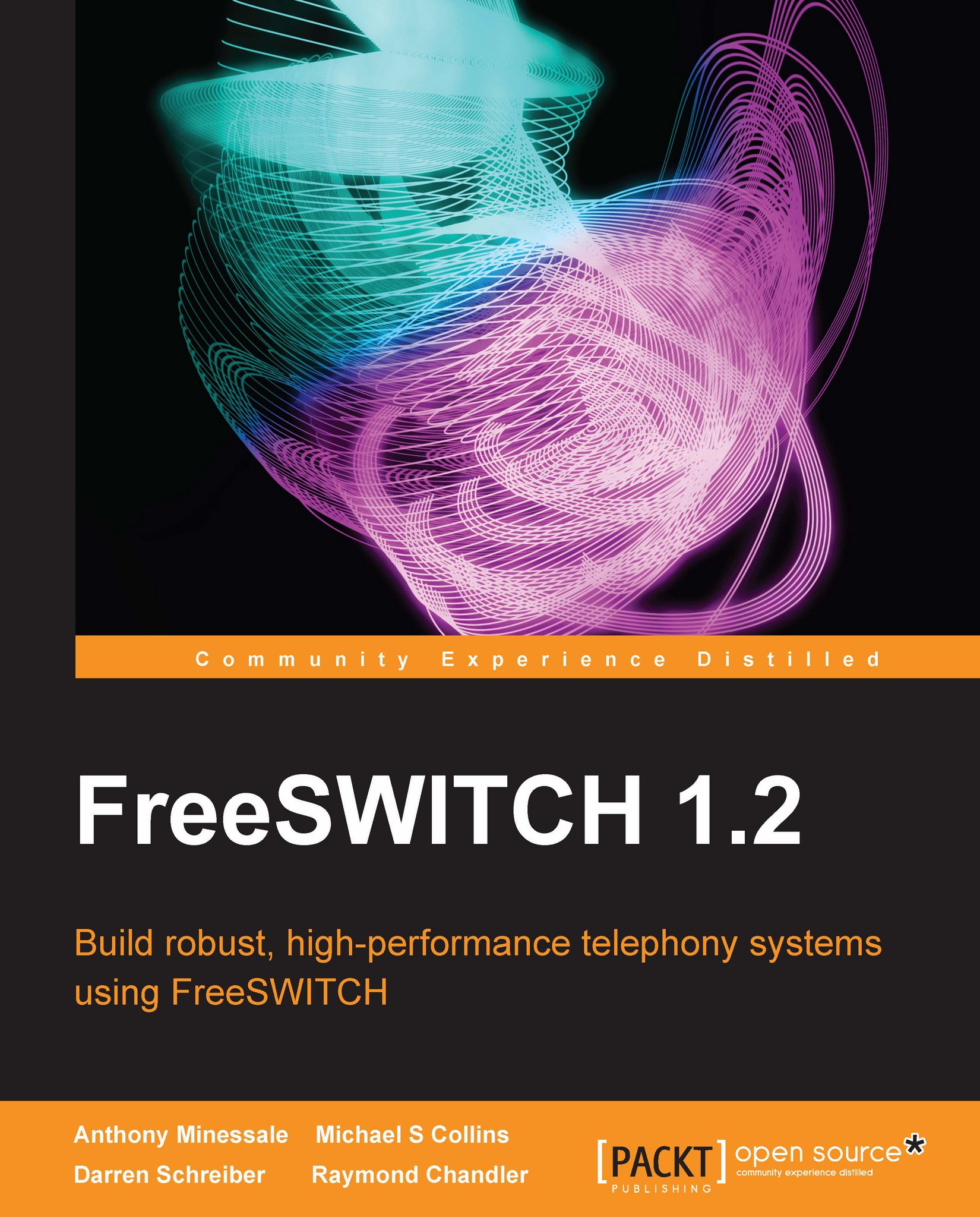
FreeSWITCH 1.2

You're reading from   FreeSWITCH 1.2 Whether you're an IT pro or an enthusiast, setting up your own fully-featured telephony system is an exciting challenge, made all the more realistic for beginners by this brilliant book on FreeSWITCH. A 100% practical tutorial.

Arrow left icon
Product type Paperback
Published in May 2013
Publisher Packt
ISBN-13 9781782161004
Length 428 pages
Edition 2nd Edition
Concepts
Arrow right icon
Authors (2):
Arrow left icon
Anthony Minessale II Anthony Minessale II
Author Profile Icon Anthony Minessale II
Anthony Minessale II
Darren Schreiber Darren Schreiber
Author Profile Icon Darren Schreiber
Darren Schreiber
Arrow right icon
View More author details
Toc

Table of Contents (19) Chapters Close

Preface 1. Architecture of FreeSWITCH FREE CHAPTER 2. Building and Installation 3. Test Driving the Example Configuration 4. SIP and the User Directory 5. Understanding the XML Dialplan 6. Using XML IVRs and Phrase Macros 7. Dialplan Scripting with Lua 8. Advanced Dialplan Concepts 9. Moving Beyond the Static XML Configuration 10. Controlling FreeSWITCH Externally 11. Web-based Call Control with mod_httapi 12. Handling NAT 13. VoIP Security 14. Advanced Features and Further Reading A. The FreeSWITCH Online Community B. Migrating from Asterisk to FreeSWITCH C. The History of FreeSWITCH Index

Chapter 7. Dialplan Scripting with Lua

In the previous chapter, we discussed the basics of building Interactive Voice Response (IVR) applications using the built-in XML IVR engine. The XML IVR engine is useful for building simple IVR applications that are relatively static in nature. FreeSWITCH has other ways of building IVR applications that are more flexible and powerful than the built-in XML IVR engine. One way is by utilizing the various scripting languages that have been integrated into FreeSWITCH. FreeSWITCH supports the following scripting languages for building voice applications:

  • JavaScript
  • Lua
  • Perl

Any of the preceding languages can be used for building IVR applications. In this chapter we will focus on using Lua (www.lua.org), a lightweight scripting language that is designed to be embedded within other projects. A famous example of which is World of Warcraft.

Tip

Each of the scripting languages has its own advantages and drawbacks. Lua is a good choice because it is fast...

lock icon The rest of the chapter is locked
CONTINUE READING
83
Tech Concepts
36
Programming languages
73
Tech Tools
Icon Unlimited access to the largest independent learning library in tech of over 8,000 expert-authored tech books and videos.
Icon Innovative learning tools, including AI book assistants, code context explainers, and text-to-speech.
Icon 50+ new titles added per month and exclusive early access to books as they are being written.
FreeSWITCH 1.2
Register for a free Packt account to unlock a world of extra content!
A free Packt account unlocks extra newsletters, articles, discounted offers, and much more. Start advancing your knowledge today.
Unlock this book and the full library FREE for 7 days
Get unlimited access to 7000+ expert-authored eBooks and videos courses covering every tech area you can think of
Renews at $19.99/month. Cancel anytime
Modal Close icon
Modal Close icon